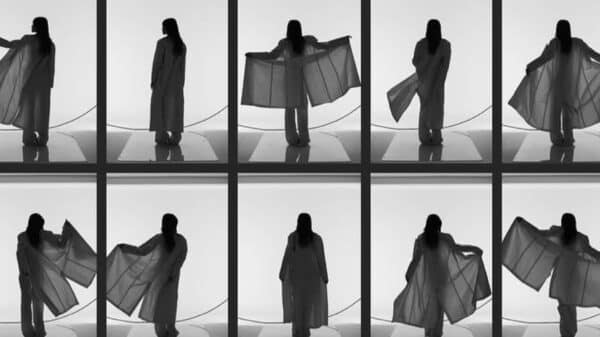









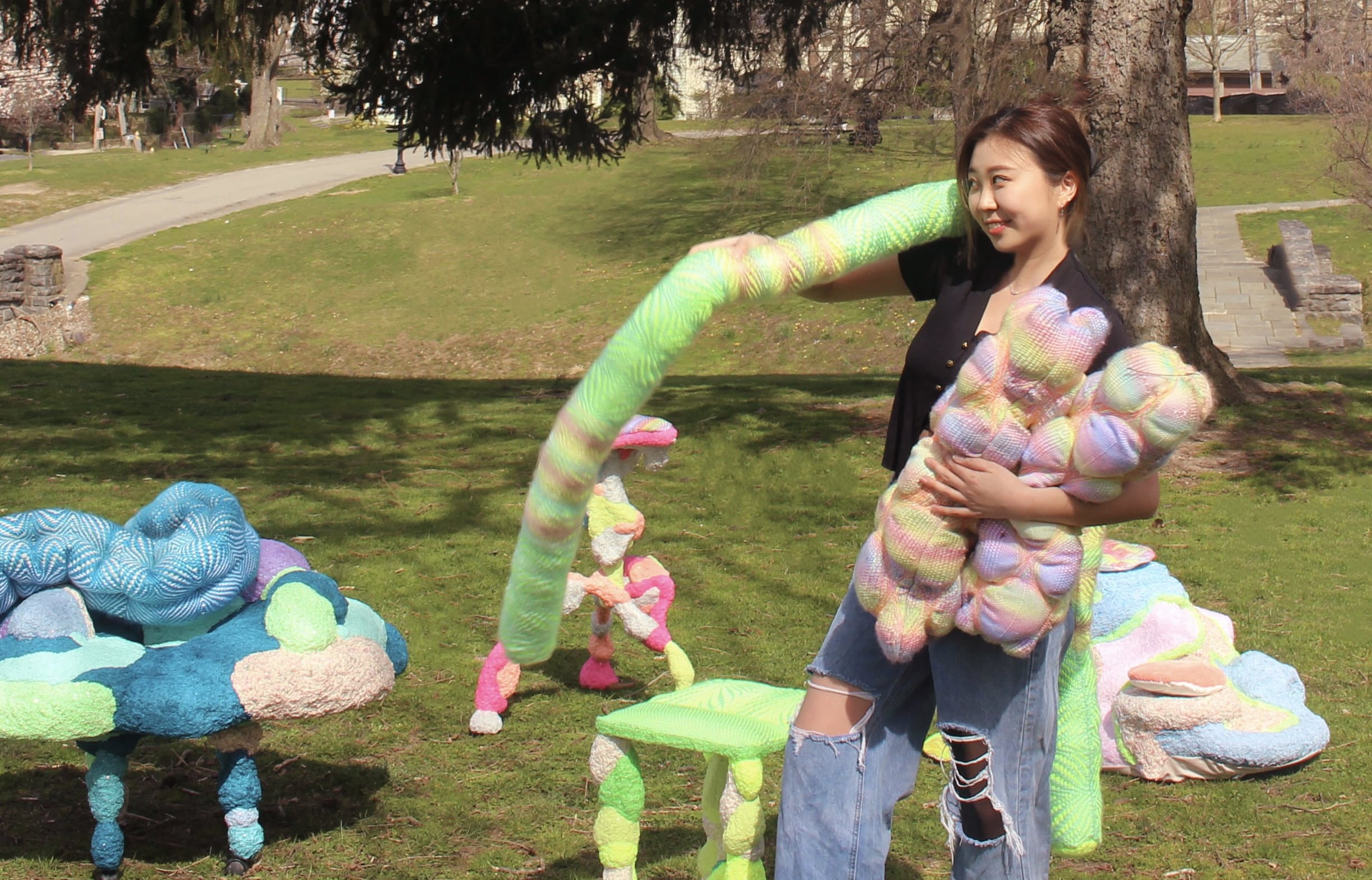
Few artists today are pushing the material boundaries of fiber with the quiet force and intellectual rigor of Ji Young Kim. Originally from South Korea and now based in New York, Kim has emerged as an internationally recognized voice in contemporary fiber art, known for her sculptural approach and her defiance of fiber’s traditionally soft associations. Her work, which blends technical mastery with emotional depth, has been exhibited globally—from Seoul to Palermo, Budapest to New York—and honored with prestigious awards including the Hand & Lock Prize for Embroidery and the Boynes Artist Award. A frequent collaborator with forward-thinking brands such as BYREDO, Econyl, and ThreeAsfour, Kim brings a uniquely tactile sensibility to everything she touches. Her installations invite presence, reflection, and reimagining. Whether she’s speaking on international panels or hand-stitching intricate surfaces, her practice insists on fiber’s strength, relevance, and capacity to hold memory and meaning.
In this conversation, Kim opens up about the instincts that drive her, the quiet rebellion behind her work, and her upcoming installation “The Gravity of Happiness.”
Adana Vincent: Let’s begin at the root—where were you born, and how has that cultural landscape influenced your creative vision?
Ji Young Kim: I was born and raised in South Korea, where I spent most of my life before moving to New York. Korea has a long tradition of craft, especially in textiles. There’s a quiet respect for handwork—even the simplest fabric carries memory, time, and gesture. That respect stayed with me.
AV: Your path into the arts unfolded organically. How did your creative life begin to take shape?
JK: There wasn’t a dramatic turning point. Drawing and choosing colors were just part of my daily rhythm—like walking home from school. It wasn’t about impressing anyone; it was how I stayed close to the world. Over time, those quiet habits—sketching, collecting textures, mixing tones—grew into a language. I didn’t call it “art” at first. It felt more like a diary without words. Eventually, I realized this space made me feel free. That’s when I knew I had to follow it.
AV: Your work often balances softness with subversion. What keeps your practice evolving?
JK: Curiosity—and a bit of rebellion. I enjoy breaking the rules of how fiber is supposed to behave. I turn something soft into something strong, something domestic into something quietly defiant. That tension drives me.
I’m drawn to overlooked things: fabric scraps, untold stories, daily patterns. I gravitate toward the in-between—between art and design, softness and structure, comfort and discomfort. Through them, I tear, twist, layer, rebuild. I trust that my hands will guide me somewhere my mind hasn’t yet gone.
AV: Tell us about your process. What’s it like behind the scenes?
JK: Emotional honesty. A sense of play. I’m drawn to the idea of touch—not only physically, but emotionally. My work often carries a playful instinct, like a surprise you didn’t know you needed. I think happiness can come from those small, open moments. Through texture, color, and form, I try to create spaces where people feel present and a little lighter.
AV: Is there a deeper message that runs through your work?
JK: Fiber holds care and history. It’s intimate, familiar—and powerful. I want my work to offer softness that’s strong, tenderness that’s brave. If someone finds comfort or stillness in a piece, that’s enough for me.
AV: What’s been a proud moment in your career?
JK: One of the most meaningful was receiving second place in the Hand & Lock Prize for Embroidery in 2023. The piece was fully hand-embroidered and challenged the idea of embroidery as decoration. I used it to build structure and presence. It looked quiet but held strong internal tension. Being recognized internationally affirmed the potential in my approach.
Another important moment came when I began to rethink fiber’s nature. Why must it always be soft or delicate? I started combining it with papermaking techniques, creating hybrid surfaces that are both sculptural and fragile. That material shift opened a new space—where the ephemeral meets the architectural.
AV: Your new project, The Gravity of Happiness, sounds powerful. Can you tell us more?
JK: It explores the emotional and physical weight of happiness. We often think of happiness as light, fleeting—but sometimes it’s slow, even heavy. Choosing it can be an act of resistance. I’m interested in that tension.
This project continues my inquiry into softness and strength. I’m building sculptural forms that appear light but hold inner pressure—like something invisible yet deeply present.
The title came to me on a walk. I thought: what if happiness isn’t something we chase, but something that already has its own gravity—waiting to be held?
I hope to debut the first version later this year. It will likely be a soft installation or furniture-like sculpture—a place where people can pause, sit, and rest inside the idea of happiness, not just observe it.
AV: What steps helped you build a sustainable career?
JK: Honoring tradition while embracing experimentation. Learning traditional textile techniques gave me grounding. But pushing material limits let me find my own voice. Building real relationships—with mentors, peers, collaborators—was also essential.
AV: What’s been your biggest challenge?
JK: Consistency. Life changes. It’s easy to lose momentum. What helped was staying committed to my curiosity—continuing to create, even when things were uncertain.
AV: Lastly, what advice would you share with aspiring artists?
JK: Trust yourself. Make what you love. Tell the stories that matter to you. Your voice is your foundation—and that’s what makes your work meaningful.