












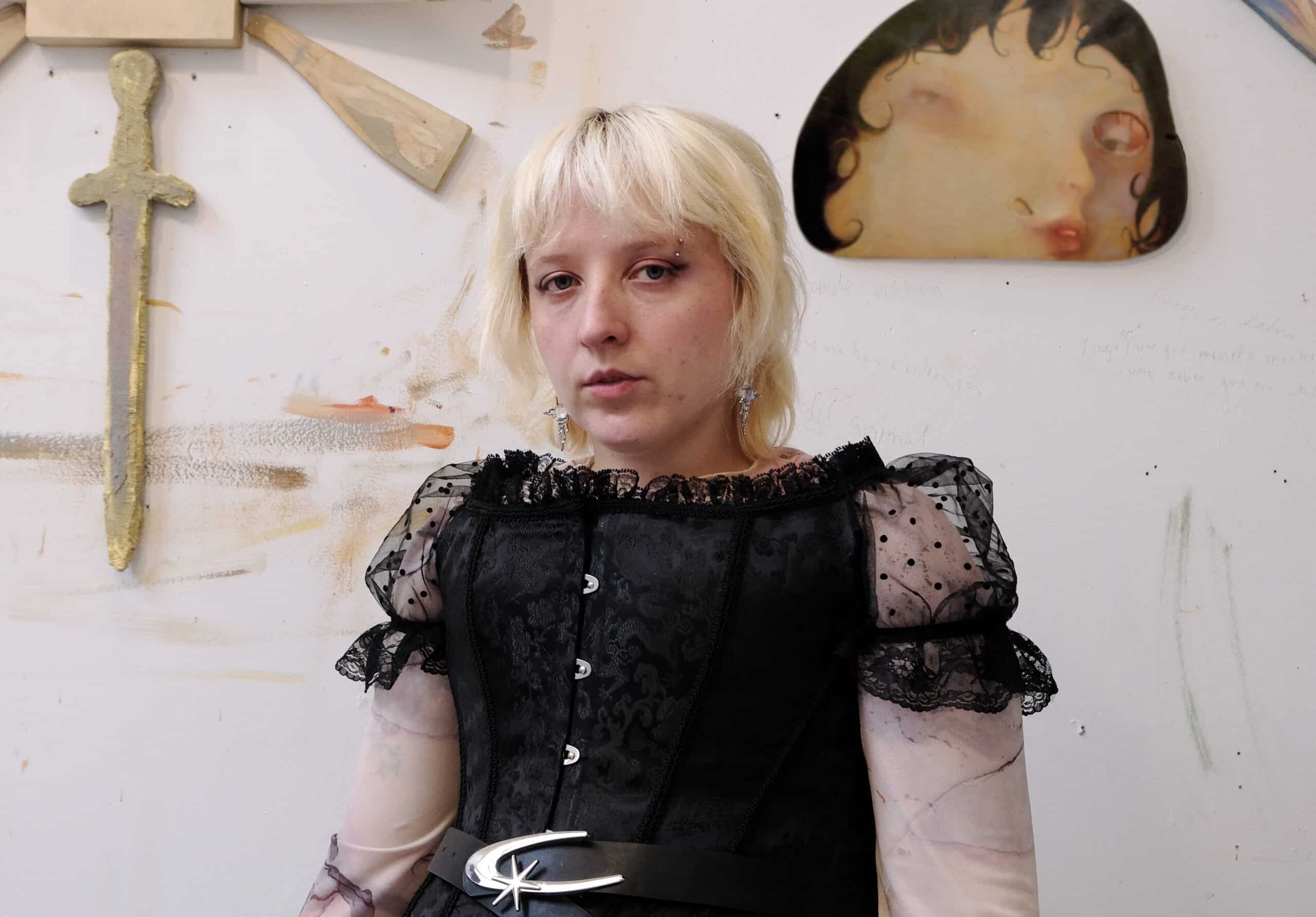
There’s a quiet assurance in Manuela Caicedo’s presence, the kind that comes from being deeply attuned to the world rather than merely observing it. The Colombian-born visual artist and designer, now based in New York, has developed a practice rooted in intuition and sensitivity, creating works that feel both deeply human and quietly transformative.
Her artistic path, which has taken her from Bogotá’s wetlands to the studios of the New York Academy of Art, is marked by a devotion to process and a respect for the mysterious rhythm of creation. Manuela’s work has been shown internationally, in Colombia, Portugal, Ireland, and the United States, and presented in spaces such as Sotheby’s, Belard Gallery, Green Family Art Foundation, Espacio Odeón, and Pontificia Universidad Javeriana, where her creative journey first began. She has been honored with some of the art world’s most coveted recognitions, including the Chubb Fellowship at the New York Academy of Art, the Elizabeth Greenshields Grant, and residencies at The Met Copyist Program at The Metropolitan Museum of Art in New York and Kylemore Abbey Global Centre, University of Notre Dame in Ireland.
As she prepares for her upcoming exhibition at the Collectors VIP Lounge at Art Basel Miami 2025, Caicedo continues to explore the intersection of imagination, materiality, and the body. In this interview, she shared insights about her origins, her process, and the quiet rebellion that lives within her art.
Martha Gutierrez: You were born in Colombia. How has growing up there shaped your perception of the world and your work?
Manuela Caicedo: I was born in Bogotá in 1993. I grew up in a neighborhood built on top of a wetland, Niza Antigua, so my childhood unfolded among the remnants of a forest that survived destruction and a building surrounded by a private garden. I learned that caring for a garden is observing life happen, and I developed a deep interest in listening to what the world has to tell us.
MG: That idea of “listening to the world” feels very present in your work. When did you realize that art was the language you wanted to use to speak back to it?
MC: I have always made things with my hands, but in 2015, I started studying Art, and that opened an infinite universe of ways to create across time and history. Discovering artists like Agnes Martin, Chantal Akerman, Jonas Mekas, María Teresa Hincapié, and Francis Alÿs showed me that I could explore the body, performance, and image in new ways. Seeing Bosch’s paintings and the gestures of Fluxus taught me that imagination is limitless and that one can always seek the reverse of artistic practice.
MG: You’re often described as an artist of intuition, someone who creates through instinct as much as through concept. What keeps that creative spark alive?
MC: It’s a combination of reading, seeing art, and living. Creativity feeds on the images we consume and a genuine interest in the world. Listening to Chantal Maillard and Carolina Sanín always returns my inspiration and desire to make images. After caring for the space for creation and nourishing it, ideas come on their own; you just have to listen and capture them before they vanish.
MG: That feels like such a grounded approach, letting inspiration find you instead of chasing it. How do you move from that first spark to a finished work?
MC: I trust intuition and believe it’s possible to think with my hands. Often the initial idea transforms while executing it, and that’s how images start to reveal themselves as I make them. I like the process to be present in the work, showing the different stages traversed to reach the final result.
MG: There’s a visible honesty in your process, each layer feels like a trace of thought. Is there a central idea or message you hope people take from your work?
MC: My practice explores the human capacity to observe and imagine. Imagination is a political and human act: it questions structures, conceives alternatives, and creates new ways of being in the world. In my body of work Las Dragonas, fire and transformations of the body represent that power, feminine strength, and the possibility of creating possible worlds from the visible and invisible.
MG: Las Dragonas has received a lot of attention, it’s powerful and visceral. What was it like presenting it at spaces like ARTBO and receiving the Chubb Fellowship?
MC: Being selected for the Chubb Fellowship at the New York Academy of Art and presenting the Chubb Fellows Show 2025 was a milestone. Presenting Las Dragonas at ARTBO Salas 2025 and developing works from doors collected in my Bogotá neighborhood were also deeply meaningful experiences.
MG: You’re about to exhibit alongside major contemporary voices at Art Basel Miami 2025. How does it feel to see your work enter that global conversation?
MC: I have participated in Chubb Fellows and Friends at the Green Family Art Foundation in Texas, exhibiting alongside artists I have admired since the beginning of my career, such as Tracey Emin, Cecily Brown, and Trey Abdella. It’s exciting to see how the Chubb Fellowship supports emerging artists and how our creative processes evolve over time.
MG: You’ve worked across different formats, drawing, film, installation, and performance. How do you decide which medium fits each idea?
MC: The medium usually reveals itself as I work. Sometimes it starts with an image or gesture that demands a particular form. The material leads the way; I follow its resistance or fragility. That’s why I like to keep traces of the process visible; it shows how thought evolves through making.
MG: You’ve also collaborated with the fashion brand LAKRAS through your Babas project and the garment “Lucky Girl Syndrome,” which was presented at New York Fashion Week 2024. How does that experience differ from your studio practice?
MC: It was a fascinating event organized by Krater, where I unveiled my latest design, the Moth Sling Bag, a companion-like creature in the form of a bag. It was truly special to see my moths take flight in New York and to witness how people connected with them. While fashion remains one of my passions, my studio practice continues to be my main focus. Still, collaborations like this are always a rewarding experience.
MG: You’ve been recognized with prestigious awards and residencies, but every artist faces setbacks. What’s been your biggest professional challenge?
MC: The pandemic was a huge challenge: I had to create with what was at hand. The house became my primary material, and the few people I could see became part of the process. These limitations opened a space for intimacy and staging, leading to my film Les dejé fresas en mi bolsillo mientras llega el día en que se apaguen los soles.
MG: Looking back, what principles have guided your success?
MC: Consistency, faith, attentive observation, and embracing mistakes as part of the process. If you stop calling an “error” a decision you made about an image you don’t like, you just keep searching until something miraculous appears. When it does, you feel it in your body.
MG: Finally, what would you tell someone just beginning their artistic path?
MC: Observe art, listen to writers, read, and write. Something inexplicable will happen inside you, and you will want to make images. You will not only learn technique; art is a mystery, and your process must be a mystery too.
Caicedo’s words echo the spirit of her work, measured, intuitive, quietly radical. She makes visible what most of us overlook: the subtle vibrations of imagination as a living, political act. As she continues to expand her reach from Bogotá to New York, and soon to Miami, her art remains rooted in something timeless, an insistence that to create is, above all, to listen.
Interview by Martha Gutierrez for The Status Life